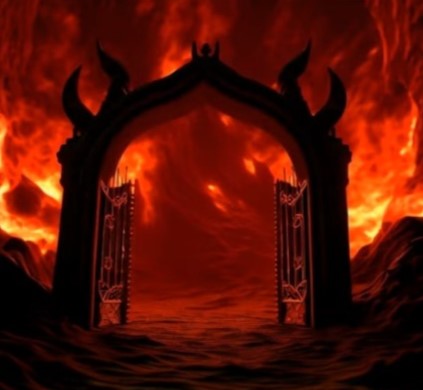
Horrifying beyond comprehension.
Let’s begin with this scripture:
If a man doesn’t remain in me, he is thrown out as a branch and is withered; and they gather them, throw them into the fire, and they are burned. (John 15:6)
Does this scripture mean burn to death or burn forever? Let’s go to John 3:
Whoever believes in the Son has eternal life, but whoever disobeys the Son will not see life, but the wrath of God remains upon him. (John 3:36)
The word remains from this scripture can be defined as “continuing to exist.” Now, we can say with confidence that the wrath God continues to exist on the disobedient. In the following scripture, the apostle Paul is speaking in the context of the order of things in the end times. Those who belong to Christ will be resurrected first, then the end will come:
The last enemy to be destroyed is death, (1 Corinthians 15:26)
In the book of Revelation, it refers to a second death. At the very end of time, the dead are standing before the throne of Jesus Christ being judged (see Revelation 20:11-12):
The sea gave up the dead who were in it. Death and Hades gave up the dead who were in them. They are judged, each one according to his works. (Revelation 20:13)
If Death and Hades give up their dead, is anyone dead? No, all are living.
In the parable of Lazarus and the rich man, Lazarus was hungry and covered in sores, and the rich man always ignored him. They both eventually died:
23 In Hades, he lifted up his eyes, being in torment, and saw Abraham far off, and Lazarus at his bosom. 24 He cried and said, ‘Father Abraham, have mercy on me, and send Lazarus, that he may dip the tip of his finger in water, and cool my tongue! For I am in anguish in this flame.’ (Luke 16:23–24)
I didn’t want to use these scriptures as evidence for hell since Death and Hades are both represented. The rich man has died and is in Hades in torment. We know that Hades gets thrown into the lake of fire near the end of Revelation. So, the rich man is in torment waiting for the judgment since Hades hasn’t yet been thrown into the lake of fire. The apostle Peter says the unrighteous are held under punishment for the day of judgment:
the Lord knows how to deliver the godly out of temptation and to keep the unrighteous under punishment for the day of judgment, (2 Peter 2:9)

In the Bible, both Peter and Paul use the term fallen asleep to describe the righteous who have died in Christ (see 1 Thessalonians 4:14 and 2 Peter 3:4). Interestingly, Paul differentiates between fallen asleep and perishing, using them in one sentence:
Then they also who are fallen asleep in Christ have perished. (1 Corinthians 15:18)
This scripture is in the context of those in Corinth who didn’t believe in a resurrection of the dead. What we refer to as hell is the “second death.”
Death and Hades were thrown into the lake of fire. This is the second death, the lake of fire. (Revelation 20:14)
We see Death and Hades together in this scripture and we see them together In Revelation 6:8. Death is on a pale green horse, and Hades is following close behind. They’re together because when those who aren’t in Christ perish from the earth, they go down alive to Hades, or Sheol (see Numbers 16:33) to wait for the final judgement. Let’s go to 2 Enoch and get a description of what awaits many people:
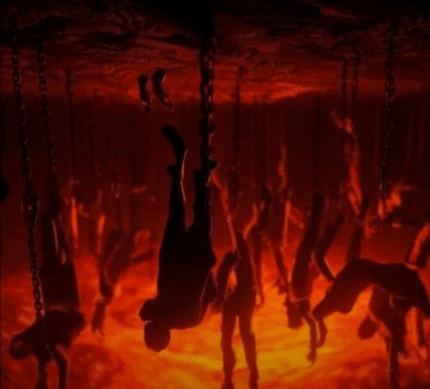
And the two men led me up on to the Northern side, and showed me there a very terrible place, and there were all manner of tortures in that place: cruel darkness and unillumined gloom, and there is no light there, but murky fire constantly flaming aloft, and there is a fiery river coming forth, and that whole place is everywhere fire, and everywhere there is frost and ice, thirst and shivering, while the bonds are very cruel, and the angels fearful and merciless, bearing angry weapons, merciless torture, and I said: Woe, woe, how very terrible is this place! (2 Enoch 10:1-2)
We see a shadow of eternal punishment in Genesis 4:10-16, in which Cain is guilty of murder. Cain says that being out of God’s presence is too much to bear. This would be true. Let’s look at the following scripture:
where their worm does not die, and the fire is not quenched. (Mark 9:48; see also Isaiah 66:24)
The worm may represent our conscience eating at us for eternity, possibly saying, “Why didn’t I listen” or “Why didn’t I change?” But like a coward, Cain is worried about his own life. God tells Cain that no one will kill him and puts a mark on him so this won’t happen. This can remind us of the mark of the beast, because once people receive the mark, they won’t die either:
And the smoke of their torment goes up for ever and ever; and they have no rest, day or night, these worshipers of the beast and its image, and whoever receives the mark of its name.” (Revelation 14:11)
Then Cain went away from the presence of the LORD, and dwelt in the land of Nod, east of Eden. (Genesis 4:16)
This scripture may tell us that those in hell will be out of God’s presence, which figurately would be east of Eden. In Genesis 3:24, it says the cherubim are placed at the east of the garden of Eden to guard the way to the tree of life. Let’s continue in Revelation:
If anyone was not found written in the book of life, he was cast into the lake of fire. (Revelation 20:15; see also 13:8, 17:8, and 21:8)
The lake of fire is also mentioned in this scripture:
The devil who deceived them was thrown into the lake of fire and sulfur, where the beast and the false prophet are also. They will be tormented day and night forever and ever. (Revelation 20:10)
If the devil, the beast, and the false prophet are tormented day and night forever and ever, what about those people who are thrown into this same lake of fire? Are they tormented forever as well, or do they just burn up and die? We can refer to the following scripture from the book of Hebrews:
but a fearful prospect of judgment and a flaming fire that is going to consume the adversaries. (Hebrew 10:27)
The second death, or lake of fire, is the flaming fire mentioned in this scripture. We know this because the flaming fire is “going to consume the adversaries.” The adversaries, the devil, the beast, and the false prophet, including Death and Hades and anyone “not found written in the book of life,” are thrown into the lake of fire. Now let’s go to Revelation 14 in regard to the mark of the beast:
9 A third angel followed them and said in a loud voice, “Anyone who worships the beast or its image, or accepts its mark on forehead or hand, 10 will also drink the wine of God’s fury, poured full strength into the cup of his wrath, and will be tormented in burning sulfur before the holy angels and before the Lamb. (Revelation 14:9–10)
In the scriptures we just read, who are these people that worship the beast? They are the “whole world”:
3 One of the heads of the beast appeared to be mortally wounded. But the mortal wound was healed, and the whole world marveled and followed the beast. 4 They worshiped the dragon who had given authority to the beast, and they worshiped the beast, saying, “Who is like the beast, and who can wage war against it?” (Revelation 13:3-4)
The whole world is worshiping the beast. The following scripture, which we used earlier, is confirmation of eternal punishment for people who accept the mark of the beast in the satanic, New World Order that’s coming. Let’s continue in Revelation 14:
The smoke of the fire that torments them will rise forever and ever, and there will be no relief day or night for those who worship the beast or its image or accept the mark of its name. (Revelation 14:11)

For those who take the mark of the beast during the hour of trail, there will be no rest day or night forever. It will be eternal torment. This will happen because Jesus will be on earth, as we see in Revelation 14:1, and people will be warned by the three angels not to take the mark of the beast from verse 11. But they’ll take it anyway, knowing full well that Jesus has come. If people find themselves in this situation, they shouldn’t take the mark of the beast. They should call on the Lord and die or be killed. People who are dead in sin must die in Christ:
I heard a voice from heaven say, “Write this: Blessed are the dead who die in the Lord from now on.” “Yes,” said the Spirit, “let them find rest from their labors, for their works accompany them.” (Revelation 14:13)
It’s better to die in the Lord rather than choose life with the beast. Our works in this life will follow us to the judgment of Jesus Christ. Let’s look at this scripture:
If Christ is in you, the body is dead because of sin, but the spirit is alive because of righteousness. (Romans 8:10)
The apostle Paul goes on to say that the Spirit who raised Christ from the dead will also give life to the body, which is dead in sin.
6 We know that our old self was crucified with him, so that our sinful body might be done away with, that we might no longer be in slavery to sin. 7 For a dead person has been absolved from sin. 8 If then, we have died with Christ, we believe that we shall also live with him. (Romans 6:6–8)
When Paul says that a dead person has been absolved from sin, he’s referring to those who have died in Christ. That is, we died to our old selves as slaves to sin and death and brought to new life in Jesus Christ becoming slaves of righteousness. If we sin from human weakness, we go to Jesus to ask for forgiveness, as it says in 1 John 2:1-2, and we should never deliberately sin. As we grow spiritually, our sins will become less and less. But let’s end the argument with this scripture:
These will go away into eternal punishment, but the righteous into eternal life.” (Matthew 25:46)
Who is Jesus speaking of when he says, “These will go off to eternal punishment?” In the context of Matthew 25, he’s talking about those who turn their backs on the hungry, the naked, and the poor.
Let’s keep Jesus’s message of faithful endurance from Revelation 3:10, the church in Philadelphia. Let’s be part of God’s chosen from Revelation 7:9, welcoming the coming of our Lord Jesus Christ with white robes and palm branches. In these last days, let’s accept Jesus as Lord and savior and turn from sinful behavior. Let’s repent from wrongdoing for the forgiveness of sins and do our best in a dying world. Let’s walk in newness of life, obeying the commandments, and we’ll receive the crown of eternal joy from God our savior.
The Lord is not slow in keeping His promise as some understand slowness, but is patient with you, not wanting anyone to perish but everyone to come to repentance. (2 Peter 3:9)
Copyright Act of 1976 17 U.S.C. § 107 allows for the use of work that is used for comment, criticism, or education. FAIR USE: Some content displayed on this video/site may contain copyrighted material the use of which has not been specifically authorized by the copyright owner. This material has been made available in our efforts to advance understanding of political, democracy, and social justice issues, etc. This is under Fair Use with purpose to educate and inform the public.


 Futile World