
While mowing, I purposely let a copperhead live. A few minutes later, I accidentally killed a garter snake.

Things we do that seem right might actually turn out to be wrong. We can apply the lesson of the snakes to one of the biggest false teachings in the world today—the pretribulation rapture. This dangerous teaching means well by saying that Jesus Christ comes to gather us before the antichrist comes. But this is unbiblical, and it might turn out to do harm to many believers in the end times. The Bible tells us the sequence of events, we simply don’t know the timing. In the 6th seal, Jesus appears on the day of the Lord (Revelation 6:16-17). On this day, the rapture happens (Revelation 7 explains the rapture), and then God’s wrath begins, as we read in Revelation 8.
False teachings are unclean food that defile the soul. In this teaching, we’re going to debunk pretribulation rapture beliefs and look at what the Bible really says. Hopefully, this will bring some to a knowledge of the truth.
The Restrainer
Many who believe in a pretribulation rapture say the antichrist won’t come until the Holy Spirit (He who restrains) has been removed, and since we’re sealed with the Holy Spirit, it stands to reason that we’ll be removed too. This erroneous teaching comes from these scriptures:
7 For the mystery of lawlessness is already at work, but the one who now restrains it will continue until he is taken out of the way. 8 And then the lawless one will be revealed, whom the Lord Jesus will kill with the breath of his mouth and bring to nothing by the appearance of his coming. (2 Thessalonians 2:7-8)
The apostle Paul is talking about the mystery of lawlessness and the revealing of the man of lawlessness, not the Holy Spirit being gone from the earth and taking believers with Him. In verse 8, Paul says “and then” the man of sin is “revealed.” All we have to do is compare verses 3 and 8. Let’s look at verse 3:
Let no one deceive you in any way, for it will not come until the rebellion occurs and the man of lawlessness—the son of destruction—is revealed. (2 Thessalonians 2:3)
The key word is revealed. The event that happens after the man of sin is “revealed” in verse 3, which is the day of the Lord, is the same event that will happen after the man of sin is “revealed” in verse 8. These aren’t two different events. The antichrist won’t be revealed two different times, once in verse 3 and again in verse 8. Verse 8 also mentions Jesus’s coming. The antichrist must be revealed in order to be killed by Jesus Christ at his coming. Will Jesus come first and then wait around for the antichrist to come in order to kill him? God restrains evil in the world and sets boundaries:
when He set a boundary for the sea, so that the waters would not surpass His command, when He marked out the foundations of the earth. (Proverbs 8:29; see Job 38:10-11)
Let’s imagine that God is the rider of a horse. He can let the reigns out or pull them back.
Departure
Saying that the word apostasy from 2 Thessalonians 2:3 means “departure” is a fairly recent false teaching, and it’s a heresy because it’s changing the word of God. This false teaching is taken from 2 Thessalonians 2:3 of the Geneva Bible.

The Geneva Bible followed the Great Bible of 1539:

The Great Bible, like the Geneva Bible, uses the word departing in 2 Thessalonians 2:3, in the context of departing from the faith. But unlike the Geneva Bible, the Great Bible is heretical. Let’s look at this scripture from the Great Bible:
Yf thou hatest her put her awaye sayeth the Lorde God of Israell and geue her clothynge for the scorne, sayeth the Lorde of Hostes. Loke well then to youre sprete, and despyse her not. (Malachi 2:16)
This scripture says, “If you hate her, put her away.” ‘Putting away’ means divorce. King Henry VIII was married many times, and the Great Bible was authorized by him.
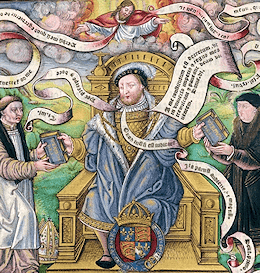
The King James Version of 1611 corrected the heretical scripture from Malachi 2:16 of the Great Bible. Let’s look at the proper translation:
For the LORD, the God of Israel, saith that he hateth putting away: for one covereth violence with his garment, saith the LORD of hosts: therefore take heed to your spirit, that ye deal not treacherously. (Malachi 2:16, KJV)
This scripture says that the Lord hates “putting away.” God hates divorce. Now, let’s look at a modern translation:
“For I hate divorce,” says the LORD, the God of Israel. “He who divorces his wife covers his garment with violence,” says the LORD of Hosts. So guard yourselves in your spirit and do not break faith. (Malachi 2:16)
We shouldn’t break faith with the spouse of our youth. Let’s move on to the scripture from the Geneva Bible in which some pretribulation teachers use to prove a pretribulation rapture:
Let no man deceive you by any means, for that day shall not come, except there come a departing first, and that the man of sin be disclosed, even the son of perdition, (2 Thessalonians 2:3)
The word departing in this translation is used for the Greek word apostasia, which means “defection” or “revolt.” It could also mean “rebellion.” It does not mean “departure”:
apostasia: defection, revolt
Original Word: ἀποστασία, ας, ἡ
Part of Speech: Noun, Feminine
Transliteration: apostasia
Phonetic Spelling: (ap-os-tas-ee’-ah)
Definition: defection, revolt
Usage: defection, apostasy, revolt.
Let’s look at the word departure as it’s used in other scriptures. In the following scripture, the word departure is used for the Greek word analyseos:
For I am already being poured out like a drink offering, and the time of my departure is at hand. (2 Timothy 4:6)
analusis: a loosing, departure
Original Word: ἀνάλυσις, εως, ἡ
Part of Speech: Noun, Feminine
Transliteration: analusis
Phonetic Spelling: (an-al’-oo-sis)
Definition: a loosing, departure
Usage: a loosing, departing, departure (from this life); (Probably a metaphor from the yoking and unyoking of transport animals).
If the Greek word analyseos was used in 2 Thessalonians 2:3 instead of apostasia, pretribulation teachers might have a case. But they don’t. The word departure is also used in 2 Peter 1 for the Greek word exodon:
And I will make every effort to ensure that after my departure, you will be able to recall these things at all times. (2 Peter 1:15)
exodos: a departure
Original Word: ἔξοδος, ου, ἡ
Part of Speech: Noun, Feminine
Transliteration: exodos
Phonetic Spelling: (ex’-od-os)
Definition: a departure
Usage: (a) an exit, going out, departure from a place; the exodus, (b) death.
Now let’s read the modern translation of 2 Thessalonians 2:3:
Let no one deceive you in any way. For that day will not come, unless the rebellion comes first, and the man of lawlessness is revealed, the son of destruction, (2 Thessalonians 2:3)
This scripture should be taken literally.
A Voice Like A Trumpet
I was in the Spirit on the Lord’s day, and I heard behind me a loud voice like a trumpet (Revelation 1:10)
When the apostle John says, “The Lord’s day”, is he talking about the day of the Lord or Sunday? John was transported (in spirit) to the day of the Lord. He hears a loud voice like a trumpet “behind him.” This might tell us that we won’t be expecting the trumpet blast from 1 Thessalonians 4:16. Let’s go to Revelation 4 in regard to the voice like a trumpet that John hears in chapter 1:
After this I looked, and there before me was a door standing open in heaven. And the voice I had first heard speaking to me like a trumpet said, “Come up here, and I will show you what must take place after this.” (Revelation 4:1)
In this scripture, some believe the apostle John represents all Christians, and that this might represent the rapture. Some pretribulation people also believe that Revelation 5:5 is the faithful Church watching the opening of the seals. In fact, this is the apostle John alone watching the opening of the seals. There are things that are figurative in the book of Revelation, but we should take these scriptures literally, not that the apostle John represents Christians. God tells John to “come up here”. The scripture doesn’t say that John was “caught up”. In chapter 11, God tells the two witnesses to “come up here” as well:
And the witnesses heard a loud voice from heaven saying, “Come up here.” And they went up to heaven in a cloud as their enemies watched them. (Revelation 11:12)
The 24 Elders
12 The city had a great and high wall with twelve gates inscribed with the names of the twelve tribes of Israel, and twelve angels at the gates. 13 There were three gates on the east, three on the north, three on the south, and three on the west. 14 The wall of the city had twelve foundations bearing the names of the twelve apostles of the Lamb. (Revelation 21:12-14)
Some believe the 24 elders from Revelation 4:4 represent Christians, probably because of the crowns and white robes. But these 24 elders are sitting on 24 thrones before the throne of God. These are the 12 sons of Jacob and the 12 apostles. These are the ones entrusted with judgment.
For there are set thrones of judgment, the thrones of the house of David. (Psalm 122:5)

Revelation 5
Some pretribulation people believe that Revelation 5:9 represents the rapture. Their argument is that the scripture mentions those who have been purchased from every tribe, tongue, people, and nation, and that it’s the church who’s singing the song. The ones singing the song are the four living creatures and the 24 elders. Let’s read the scriptures:
8 When He had taken the scroll, the four living creatures and the twenty-four elders fell down before the Lamb. Each one had a harp, and they were holding golden bowls full of incense, which are the prayers of the saints. 9 And they sang a new song: “Worthy are You to take the scroll and open its seals, because You were slain, and by Your blood You purchased for God those from every tribe and tongue and people and nation. (Revelation 5:8-9)
Just because the Lamb purchased for God those from every tribe, tongue, people, and nation doesn’t mean they’re in heaven at this point. The image above, which is from about the year 1330, can show us this.
Church Not Mentioned After Revelation 3
Many pretribulation people say the Church isn’t mentioned after Revelation 3, even though the rapture happens in Revelation 7. If the Church is raptured before this, it must be in Scripture, but it’s not. We see believers as far as Revelation 14. Let’s prove it with the following scriptures:
And the dragon was enraged at the woman, and went to make war with the rest of her children, who keep the commandments of God and hold to the testimony of Jesus. (Revelation 12:17)
Then the beast was permitted to wage war against the saints and to conquer them, and it was given authority over every tribe and people and tongue and nation. (Revelation 13:7)
These saints are those who have come to faith during the wrath of God and believers who have been left behind. They are being subjected to the final test.
“If anyone is destined for captivity, into captivity he will go; if anyone is to die by the sword, by the sword he must be killed.” Here is a call for the perseverance and faith of the saints. (Revelation 13:10)
Here is a call for the perseverance of the saints who keep the commandments of God and the faith of Jesus. (Revelation 14:12)
The faith of Jesus is being obedient to death.
REVELATION 12
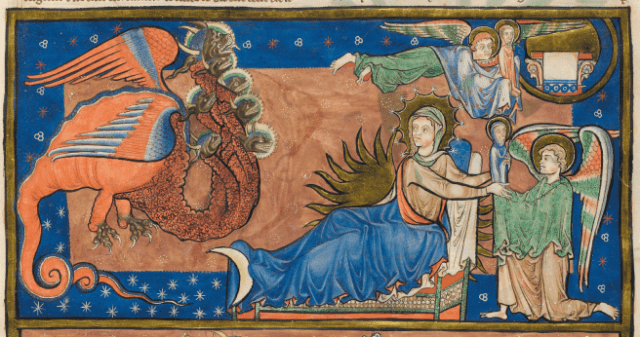
(Revelation 12:4-6)
In Revelation 12, the woman who gives birth to the male child does so in great pain:
She was pregnant and crying out in the pain and agony of giving birth. (Revelation 12:2)
This can remind us of Genesis 3:16, in which God tells Eve that he will multiply her pain in childbirth. We know that by the crucifixion of Jesus Christ, the church was born in great pain. Jesus died for our sins and was raised for our justification. In Revelation 12:5, the male child is “caught up” to God, while the woman is given the wings of an eagle to fly into the wilderness where she’ll be nourished for a time, and times, and half a time, which is three and a half years. The male child represents believers, and the woman represents the nation of Israel. In verse 5, it says the child is to rule the nations with an iron rod. We know that Jesus will rule with an iron rod from Revelation 19:15. In Revelation 2, Jesus tells the church in Thyatira that “he who conquers”, Jesus will give him power over the nations:
and he shall rule them with a rod of iron, as when earthen pots are broken in pieces, even as I myself have received power from my Father; (Revelation 2:27)
In Revelation 12:13, it says the dragon pursues the woman who gave birth to the male child. We know that Mary the mother of Jesus was a Jew under the law when she gave birth to Jesus. Jesus uses the word woman in the gospels. He calls his mother “woman” in John 2:4 at the wedding feast in Cana, and he calls her “woman” from the cross in John 19:26. Jesus says to his mother, “Woman, behold your son.” Then he says to the apostle John, “Behold, your mother.” So then, didn’t the nation of Israel give birth to Christians? Yes, it did. We Gentiles are grafted into the olive tree. Is Jesus a Jew? Yes, he is, and we know this from John 4:9. But isn’t Ruth, David’s great-grandmother, a Moabite woman, a Gentile? And isn’t Rahab, a Canaanite woman, a Gentile as well? Aren’t these two Gentile women in Jesus’s bloodline? Yes, they are, and we can see this in Matthew 1, the genealogy of Jesus Christ. So, in Revelation 12, the male child represents the Church, the household of God, and the woman represents the nation of Israel. Revelation 12:17 says the dragon goes off to wage war against “the rest” of the woman’s offspring. The rest of the woman’s offspring are those who keep God’s commandments and the faith of Jesus.
For I hear a cry like a woman in labor, a cry of anguish like one bearing her first child—the cry of the Daughter of Zion gasping for breath, stretching out her hands to say: ‘Woe is me, for my soul faints before the murderers!’” (Jeremiah 4:31)
Revelation 12 is a picture of the rapture, even though this chapter is after the 7th trumpet in chapter 11.
In these last days, let’s keep the faith no matter what happens in this dying world. Let’s stay obedient to Jesus Christ even to death.
And that, considering the season, that it is now time that we should arise from sleepe: for now is our saluation neerer, then when we beleeued it. (Romans 13:11, Geneva Bible)
Peace to all in our Lord Jesus Christ.

Copyright Act of 1976 17 U.S.C. § 107 allows for the use of work that is used for comment, criticism, or education. FAIR USE: Some content displayed on this video/site may contain copyrighted material the use of which has not been specifically authorized by the copyright owner. This material has been made available in our efforts to advance understanding of political, democracy, and social justice issues, etc. This is under Fair Use with purpose to educate and inform the public.

 Futile World