Because of this, some of the Pharisees said, “This man is not from God, for He does not keep the Sabbath.”
Jesus Christ didn’t keep the Sabbath:
16 Now because Jesus was doing these things on the Sabbath, the Jews began to persecute Him. 17 But Jesus answered them, “To this very day My Father is at His work, and I too am working.” 18 Because of this, the Jews tried all the harder to kill Him. Not only was He breaking the Sabbath, but He was even calling God His own Father, making Himself equal with God. (John 5:16-18)
Changing what we believe can be difficult, like going against the grain. Sometimes we have to go against the grain to get to the truth. So, what’s the truth of keeping the Sabbath? It’s the fourth commandment, isn’t it? God says that if we love him, we’ll keep his commandments. But Israel wasn’t keeping God’s commandments. God says in Ezekiel that Israel was profaning his Sabbaths:
because they kept rejecting My ordinances, refusing to walk in My statutes, and profaning My Sabbaths; for their hearts continually went after their idols. (Ezekiel 20:16)
This was still going on when Jesus Christ came.
Let’s go to the beginning of Jesus’s ministry. At the wedding feast in Cana in John 2:6-8, Jesus uses the six stone water jars that were used for Jewish ceremonial washings to turn 120-180 gallons water into wine. We know that the Jews didn’t eat until they washed their hands, ceremonially:
Now in holding to the tradition of the elders, the Pharisees and all the Jews do not eat until they wash their hands ceremonially. (Mark 7:3; see also Luke 11:38)
By turning the water into wine, Jesus is beginning to break the ceremonial traditions of the elders. Let’s listen to Jesus in Mark 2:
Then Jesus declared, “The Sabbath was made for man, not man for the Sabbath. Therefore, the Son of Man is Lord even of the Sabbath.” (Mark 2:27-28)
When Jesus says he’s Lord of the Sabbath, he’s telling us that he has the divine authority to do as he pleases. And what was Jesus doing when he said he’s Lord of the Sabbath? He was allowing his disciples to pick grain and eat on the Sabbath day:
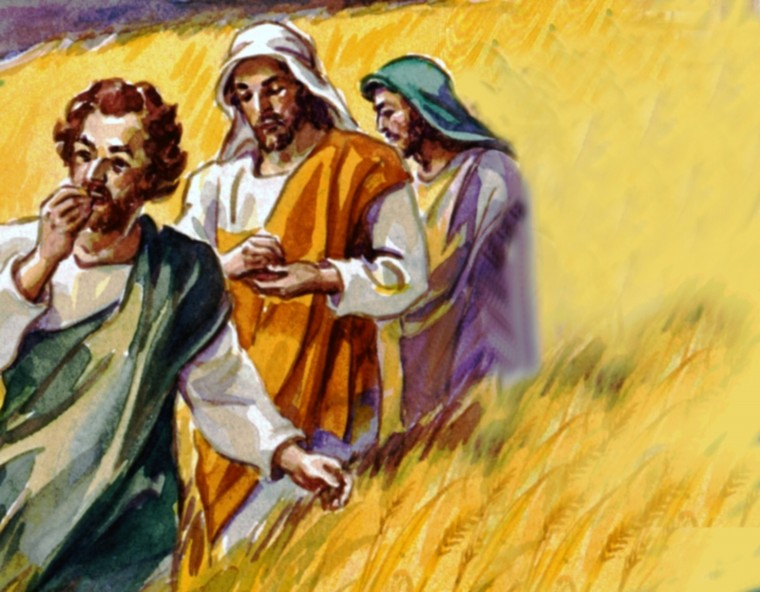
According to the law (and by Jesus breaking the Sabbath), the disciples were not doing anything wrong by eating:
When you enter your neighbor’s grainfield, you may pluck the heads of grain with your hand, but you must not put a sickle to your neighbor’s grain. (Deuteronomy 23:25)
Jesus also breaks the Sabbath by healing:
1 Once again Jesus entered the synagogue, and a man with a withered hand was there. 2 In order to accuse Jesus, they were watching to see if He would heal on the Sabbath. 3 Then Jesus said to the man with the withered hand, “Stand up among us.” 4 And He asked them, “Which is lawful on the Sabbath: to do good or to do evil, to save life or to destroy it?” But they were silent. 5 Jesus looked around at them with anger and sorrow at their hardness of heart. Then He said to the man, “Stretch out your hand.” So, he stretched it out, and it was restored. 6 At this, the Pharisees went out and began plotting with the Herodians how they might kill Jesus. (Mark 3:1-6)
Jesus breaks the Sabbath by ordering a man who was healed to carry his mat:
8 Then Jesus told him, “Get up, pick up your mat, and walk.” 9 Immediately the man was made well, and he picked up his mat and began to walk. Now this happened on the Sabbath day, 10 so the Jews said to the man who had been healed, “This is the Sabbath! It is unlawful for you to carry your mat.” (John 5:8-10)
Jesus breaks the Sabbath again by spitting to make clay, which he uses to heal a man born blind:
Now the day on which Jesus had made the mud and opened his eyes was a Sabbath. (John 9:14)
In the following scripture, Jesus ascends to heaven from Mount Olivet:
Then they returned to Jerusalem from the mountain called Olivet, which is near Jerusalem, a Sabbath day’s journey away. (Acts 1:12)
We see the apostles travelling on the Sabbath day. We know that in the law of Moses, it was forbidden to travel on the Sabbath day:
Behold, because Yahweh has given you the Sabbath, therefore he gives you on the sixth day the bread of two days. Everyone stay in his place. Let no one go out of his place on the seventh day.” (Exodus 16:29)
If we feel we have to observe the Sabbath, could this be trying to be justified by the law? The apostle Paul tells us that according to the law, we must do everything written in the law or we’re under a curse:
All who rely on works of the law are under a curse. For it is written: “Cursed is everyone who does not continue to do everything written in the Book of the Law.” (Galatians 3:10)
The law is good, but we don’t try to be justified by the law, such as with circumcision. Our faith upholds the law. Do those who keep the Sabbath day also keep the Sabbath month, the Sabbath year, and the Jubilee? According to the law of Moses, they have to. God tells Moses to tell the Israelites to, “Keep my Sabbaths,” plural:
“Tell the Israelites, ‘Surely you must keep My Sabbaths, for this will be a sign between Me and you for the generations to come, so that you may know that I am the LORD who sanctifies you. (Exodus 31:13)
Each of you must respect his mother and father, and you must keep My Sabbaths. I am the LORD your God. (Leviticus 19:3)
When God refers to the Sabbath day, he says, “Sabbath”:
For six days work may be done, but the seventh day is a Sabbath of complete rest, holy to the LORD. Whoever does any work on the Sabbath day must surely be put to death. (Exodus 31:15)
God goes on to say that observing the Sabbath is an everlasting sign between him and the Israelites:
It is a sign between Me and the Israelites forever; for in six days the LORD made the heavens and the earth, but on the seventh day He rested and was refreshed.’ ” (Exodus 31:17)
Those with faith are true Israelites, not Jews outwardly, but inwardly. We’re circumcised in heart. We Gentiles have been grafted into the Olive Tree. We’re now part of the household of God, the commonwealth of Israel, which is the church of the living God. The Sabbath rest for the people of God is entering into God’s rest:
9 There remains, then, a Sabbath rest for the people of God. 10 For whoever enters God’s rest also rests from his own work, just as God did from His. (Hebrews 4:9–10)
The Seventh-day rest is a shadow of the millennial reign of Christ. Jesus will reign on earth for a thousand years. This will be the 1000-year Sabbath, the 7th day. Let’s read the following excerpt from Against Heresies:
For in as many days as this world was made, in so many thousand years shall it be concluded. And for this reason, the Scripture says: “Thus the heaven and the earth were finished, and all their adornment. And God brought to a conclusion upon the sixth day the works that He had made; and God rested upon the seventh day from all His works.” This is an account of the things formerly created, as also it is a prophecy of what is to come. For the day of the Lord is as a thousand years; and in six days created things were completed: it is evident, therefore, that they will come to an end at the sixth thousand year. —Irenaeus, Against Heresies (Book V, Chapter 28, paragraph 3)
God tells Israel in Isaiah 58 that if they stop following their own ways on the Sabbath, they will take delight in him.
13 If you turn your foot from breaking the Sabbath, from doing as you please on My holy day, if you call the Sabbath a delight, and the LORD’s holy day honorable, if you honor it by not going your own way or seeking your own pleasure or speaking idle words, 14 then you will delight yourself in the LORD, and I will make you ride on the heights of the land and feed you with the heritage of your father Jacob.” For the mouth of the LORD has spoken. (Isaiah 58:13-14)
The Jews were doing as they pleased on God’s holy day, the Sabbath. So, why wouldn’t Jesus break the Sabbath?
In the fourth commandment, God was telling the Israelites to rest from their six days of labor. The Jews bound themselves as slaves to the Sabbath with self-made rules, and some Christians do the same. Sunday, the first day of the week, is the Lord’s Day now. In the following scripture, it is early Sunday morning, the first day of the week, when Jesus was resurrected:
Now on the first day of the week, Mary Magdalene went early, while it was still dark, to the tomb, and saw the stone taken away from the tomb. (John 20:1)
Eighty years after Mary arrived at the tomb of Jesus, we can see how this new tradition, the first day of the week, still dark and early, continued. We get an interesting look at our new first day of the week tradition from the perspective of outsiders—pagan Rome. Epistulae X.96 is included in the following quote from The New Testament Documents by F. F. Bruce:
In AD 112, C. Plinius Secundus (Pliny the Younger), governor of Bithynia in Asia Minor, wrote a letter to the Emperor Trajan, asking his advice on how to deal with the troublesome sect of Christians, who were embarrassingly numerous in his province. According to evidence he had secured by examining some of them under torture, ‘they were in the habit of meeting on certain fixed day before it was light, when they sang an anthem to Christ as God, and bound themselves by a solemn oath (sacramentum) not to commit any wicked deed, but to abstain from all, fraud, theft and adultery, never to break their word, or deny a trust when called upon to honour it; after which it was their custom to separate, and then meet again to partake of food, but food of an ordinary and innocent kind.’
Comparing the scripture from John 20:1 and this letter from Pliny the Younger to Emperor Trajan, it’s easy to see that the Sabbath is a thing of the past. Sunday is this “certain fixed day” mentioned in the letter. We can simply subtract from the seventh day to know the first day of creation was a Sunday. God brought the universe to life on the first day. He created light and separated it from the darkness. Jesus Christ was brought back to life on the first day of the week.
So, why did God make the last day of the week, the Sabbath day, holy in the first place? Was it because he rested on the seventh day? Simply put, God commanded the Israelites to observe the Sabbath day to remember they were once in slavery, and he brought them out with a strong hand:
Remember that you were a slave in the land of Egypt, and that the LORD your God brought you out of there with a mighty hand and an outstretched arm. That is why the LORD your God has commanded you to keep the Sabbath day. (Deuteronomy 5:15)
The Jews were not remembering that God brought them out of slavery in Egypt with a mighty hand.
As the Israelites were brought to freedom from life in slavery, so we who are in Jesus Christ are brought to new life from the slavery of sin and death. As the Israelites journeyed through the wilderness in their earthly lives, so we journey through the wilderness in our spiritual lives. But if we choose to observe a day that’s special to us, such as a birthday, a holiday, or the Sabbath day, let’s observe it for the Lord, not because we have to.
One man esteems one day as more important. Another esteems every day alike. Let each man be convinced in his own mind. (Romans 14:5)
As God created the heavens, the earth, and light on the first day and raised Christ from the dead on the first day of the week, so those who have faith in Jesus Christ are a new creation, and we worship on the first day of the week. We celebrate our freedom from slavery to sin and death to new life in Jesus Christ on the Lord’s Day, Sunday. Peace to everyone and may our Lord Jesus Christ return soon.
Copyright Act of 1976 17 U.S.C. § 107 allows for the use of work that is used for comment, criticism, or education. FAIR USE: Some content displayed on this video/site may contain copyrighted material the use of which has not been specifically authorized by the copyright owner. This material has been made available in our efforts to advance understanding of political, democracy, and social justice issues, etc. This is under Fair Use with purpose to educate and inform the public.

 Futile World