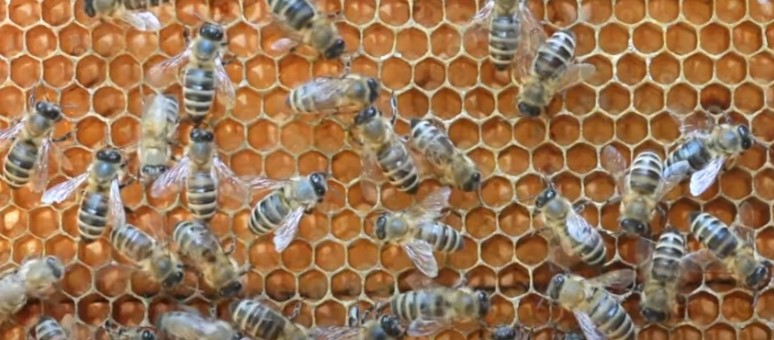
The hexagonal cells in honey bee hives have been admired for thousands of years. The honeycomb conjecture tells us why honey bees use hexagons:
The Honeycomb Conjecture is a mathematical theory that proposes that a hexagonal grid or honeycomb pattern is the most efficient way to divide a surface into regions of equal area with the least total perimeter. This means that hexagons use the least amount of material to enclose a given area compared to other shapes like squares or triangles. (1)
Honey bees use the hexagonal shape for optimizing space. But understanding how and not just why could benefit us in conservation efforts. Here’s the hypothesis on how honey bees form hexagons: Honey bees use sound waves at the right pitch propagated by wingbeats and use heat at the right temperature generated by vibrating flight muscles to make beeswax malleable for the formation of hexagonal cells in the honeycomb.
Honey bees generate heat through a process known as shivering thermogenesis. They have behavioral and physiological mechanisms for regulating the temperature of their flight muscles. (2) The heat generated by honey bees not only serves to warm up the hive on cold days but keeps wax pliable during the building process. “During the construction of hexagonal cells, wax temperature is between 33.6–37.6 °C (92.5–99.7 °F), well below the 40 °C (104 °F) temperature at which wax is assumed to be liquid for initiating new comb construction.” (3) By vibrating the flight muscles, honey bees can raise their body temperature to around 35°C (95°F), which is crucial for wax secretion. (4)
It’s been said by scientists that while the honeycomb cells are still circular and warm, they are pulled by surface tension into hexagons. (5) Others believe the wax settles into hexagons naturally during the cool down phase. This is said to happen due to a phenomenon called self-organizing structures, in which the hexagonal pattern emerges as the wax cools and hardens. The following two quotes are from the article Self-organization at the first stage of honeycomb construction:
“There are two primary viewpoints on how the frames become hexagonal. One is that the precise structure is simply a result of the law of physics. Pirk et al. argued that the bees’ body heat increases the temperature in the vicinity of the cylindrical holes until the wax reaches a liquid equilibrium state, after which simple mechanical surface tension causes the hole frames to be hexagonal [13]. Meanwhile, Karihaloo et al. proved that, under the liquid equilibrium hypothesis that results from surface tension, the softened wax could be thinned so that the hexagonal frame would appear spontaneously [14]. However, Bauer and Bienefeld showed that the bees constructing honeycomb do not heat the wax to a temperature that would allow it to reach a liquid equilibrium state [15]. In addition, Oeder and Schwabe stated that any wax flows which could influence the cell geometry do not occur [16]. The other viewpoint posits that honeybees are competent engineers acting under simple rules.”
“Taken as a whole, our results highlight the possibility that the first process of honeycomb construction arises from self-organization. The major roles of worker bees in our model are wax attachment and excavation, which cause the inflow and outflow of wax. In other words, the system is open and non-equilibrium with regard to wax, and the patterns in this model are thus dissipative structures.” (6)
It’s natural to come to these conclusions if the idea of acoustics is not considered. The heat generated from the vibrating wing muscles softens the wax, making it malleable for the formation of the hexagons by the propagation of sound waves from wingbeats. Honey bees beat their wings around 230 beats per second, creating sound waves. As they beat their wings, they displace air, causing vibrations that is perceived as buzzing. The frequency of the wingbeats determines the pitch of the buzz. The faster the wingbeats, the higher the pitch. For example, mosquitos flap at a frequency of over 400 beats per second. (7) We can also use buzz pollination from bumblebees as an example as well. In regard to honey bees, the pitch and temperature form the hexagonal cells. A single honey bee is most likely capable of doing both the heat generation and the wingbeats or performing only one of these two activities.
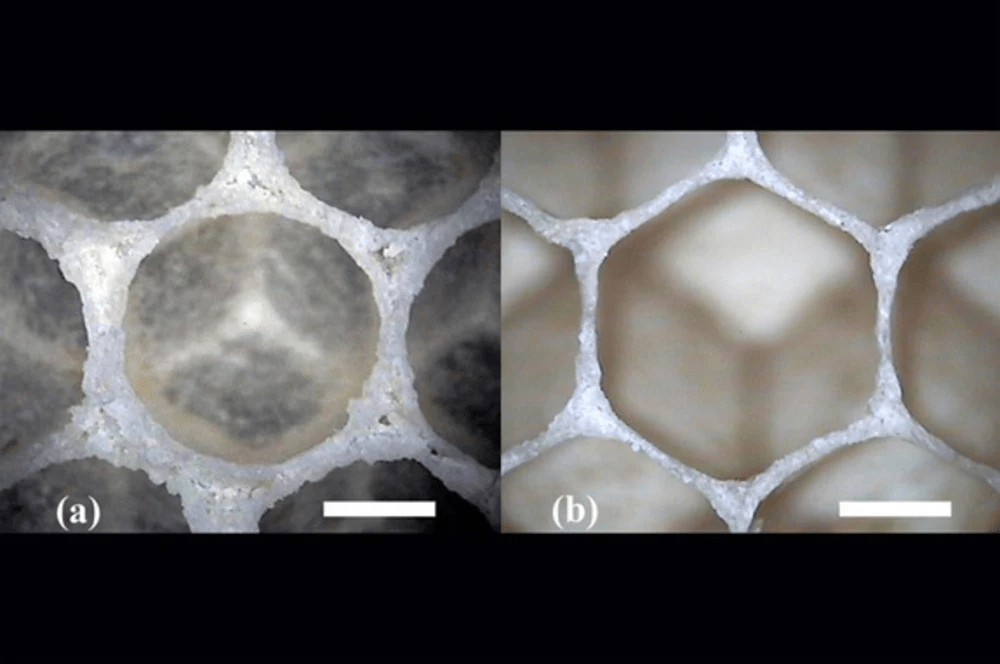
Honeycomb cells begin in a circular shape. The next step is where the difference is: “By heating the cells, the bees cause the wax to become molten and flow like lava. Once the wax starts flowing, the cell walls naturally fall flat and take on the shape of a hexagon.” “The team still does not know exactly how the bees go about heating each cell.” The honey bees work as a unit heating each cell using non-flight thermogenesis. “Circular cells should morph into hexagons within six seconds” (8). During this brief moment of time of six seconds, non-flight vibrations cause the hexagons to form.
What role festooning might have to play is still to be determined. The function of the living chain that is formed by bees where new combs are being built, or old combs repaired, is completely unknown. Jürgen Tautz, German bee biologist. Festooning happens inside the hive while the bees are building or repairing the honeycomb. They form a living scaffold, a chain-like structure, by hanging together from each other’s legs. These chains are thought to help bees measure distances and align the new comb being constructed. Festooning might be instrumental in the formation and manipulation of wax to create the honeycomb’s hexagonal cells. Festooning bees are often involved in wax secretion and produce as much wax as other bees in the same age group who are not festooning. Because of observations like these, general agreements can’t be reached. But it could be during festooning, the bees working as a unit, that newly formed honeycomb cells take their final shape into hexagons from heat and sound waves.
While arguing against acoustics, one scientist said there is no reason and no need to see the formation of hexagons in honeycombs not based on a thermal equilibrium process but added that there are still NO direct observations of the details of the comb building process in honeybees.
The medium through which sound waves are propagated by honey bees is air, which is in a mixture of gases, and the role of acoustics in the formation of hexagons is the same concept we see on Saturn’s north pole. Let’s go to Saturn.
Saturn’s north pole hexagon is formed by sound waves emitted from deep within the vortex.
Saturn is the sixth planet from the sun and the second largest planet in the solar system. It is a gas giant with a radius of about nine and a half times the size of the earth. Saturn’s north pole has a persistent, hexagonal cloud pattern.

Many hypotheses have been developed for Saturn’s hexagon. Now, let’s consider acoustics.
Sound is a vibration that propagates as an acoustic wave through a transmission medium such as a gas, liquid or solid.
We cannot go into Saturn’s atmosphere to listen to the sounds, but we can pick up Saturn’s intense radio emissions and convert them into audio recordings.
The hexagon rotates with a period of 10h 39m 24s, the same period as Saturn’s radio emissions from its interior. The hexagon does not shift in longitude like other clouds in the visible atmosphere. (9)
Let’s look at Saturn’s atmosphere:
The main components of Saturn’s atmosphere are, by volume: hydrogen (96.7%), helium (3%), methane (0.2%), ammonia (0.02%), and water vapor (unknown percentage, estimated at 0.4%). (10)
So, the bulk of Saturn’s atmosphere is 96.3% molecular hydrogen and 3.25% helium by volume. Not all gas molecules have the same mass. Oxygen is denser than helium, so sound waves travel more slowly through Oxygen. Because helium (molecular weight 4) and hydrogen (molecular weight 2) are lighter than oxygen (molecular weight 32), sound travels faster. Temperature is also a factor, and Saturn has a temperature of about 288 degrees Fahrenheit. The temperature increases the closer we get to the center.
Deep in the atmosphere of Saturn, the pressure is 100,000 times that of earth. At these pressures, hydrogen behaves like a liquid. The speed of sound depends on the density of the medium which it’s travelling through. The speed of sound usually travels faster in liquids than gases and faster in solids than liquids.
The vortex is the source of the sound. How vortices generate sound is a nonlinear process. There’s not a simple explanation.
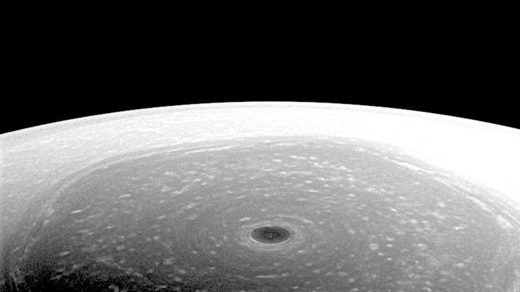
In most vortices, the fluid flow velocity is greatest next to its axis and decreases in inverse proportion to the distance from the axis.
But Saturn’s north pole is a rotational vortex:
A rotational vortex is a vortex that rotates in the same way as a rigid body. It cannot exist indefinitely in that state except through the application of some extra force, that is not generated by the fluid motion itself. It has non-zero vorticity everywhere outside the core. Rotational vortices are also called rigid-body vortices or forced vortices. (11)
Sound vibrations from deep inside Saturn form the hexagon, which appears to be stationary even though the gases continue to rotate. The hexagon appears as a border, in the sense that the gases within the hexagon appear to have a different hue than the gases outside the hexagon, even when it changes color.

The following image is a comparison of sound vibrations at 432 Hz and 440 Hz in water. The sound vibration at 440 Hz doesn’t need a vortex to form a hexagon but still has a central point:
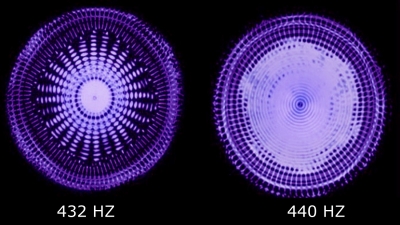
Sound vibrations make different shapes at different frequencies in different liquids, such as cooking oil. So, we must know the frequency and the type of liquid. The hexagon on Saturn could be made from sound vibrations in liquid hydrogen deep within the atmosphere. The sound itself could be generated by the vortex. The hexagon in the water sound image above doesn’t need a vortex because the sound is introduced from an outside source. How a vortex generates sound is a still a theory:
Based on the observation that a vortex ring induces the same hydrodynamic (incompressible) flow as does a dipole sheet of the same shape, simple physical arguments for sound generation by vorticity are presented, first in terms of moving vortex rings of fixed strength and then of fixed rings of variable strength. These lead to the formal results of the theory of vortex sound, with the source expressed in terms of the vortex force ρ(u∧ ζ) and of the form introduced by Mo¨hring in terms of the vortex moment (y∧ ζ′), (ρ is the constant fluid density, u the flow \velocity, ζ = ∇ ∧u the vorticity and y is the flow coordinate). (12)
The water sound image above is in the context of Robert Boerman’s article on Water Sound Images for Frontier Magazine. (13) He received requests to apply this to music in the context of 432 Hz versus 440 Hz. The standard was set at 440 Hz, but some musicians and those who believe in healing properties of frequencies prefer 432 Hz, though they say 440 Hz has beneficial properties as well. As a composer, the key of A tuned to 440 Hz sounds more natural.
1. Why do bees build hexagonal honeycombs? – Forces of Nature with Brian Cox: Episode -1 BBC
2. Heinrich, B. (1996). How the honey bee regulates its body temperature. Bee World, 77(3),
130–137. https://doi.org/10.1080/0005772X.1996.11099304.
3. Bauer, D; Bienefeld, K (2013). “Hexagonal comb cells of honeybees are not produced via a liquid equilibrium process”. Naturwissenschaften. 100 (1): 45-9. Bibcode:2013NW….100…45B. doi:10.1007/s00114-012-0992-3. PMID 23149932. S2CID 11552726. https://en.wikipedia.org/wiki/Honeycomb
4. Artificial Intelligence Search
6. Self-organization at the first stage of honeycomb construction: Analysis of an attachment-excavation model Takayuki Narumi 1,*, Kenta Uemichi 2, Hisao Honda 3,4, Koichi Osaki 2 https://pmc.ncbi.nlm.nih.gov/articles/PMC6200235/
7. https://www.caltech.edu/about/news/deciphering-mystery-bee-flight-1075
9. Godfrey, D. A. (1990). “The Rotation Period of Saturn’s Polar Hexagon”. Science. 247 Bibcode:1990Sci…247.1206G. doi:10.1126/science.247.4947.1206. PMID 17809277. S2CID 19965347.
10. https://www.mira.org/fts0/planets/100/text/txt002x.htm
11. https://en.wikipedia.org/wiki/Vortex
12. Alan Powell. Department of Mechanical Engineering, University of Houston, Houston, TX 77204-4792 J. Mech. Des. Jun 1995, 117(B): 252-260 (9 pages) https://doi.org/10.1115/1.2836464
13. https://wonderinspirit.wordpress.com/2011/10/10/water-sound-images-of-432-hz-and-440-hz/
Copyright Act of 1976 17 U.S.C. § 107 allows for the use of work that is used for comment, criticism, or education. FAIR USE: Some content displayed on this video/site may contain copyrighted material the use of which has not been specifically authorized by the copyright owner. This material has been made available in our efforts to advance understanding of political, democracy, and social justice issues, etc. This is under Fair use with purpose to educate and inform the public.

 Futile World